M
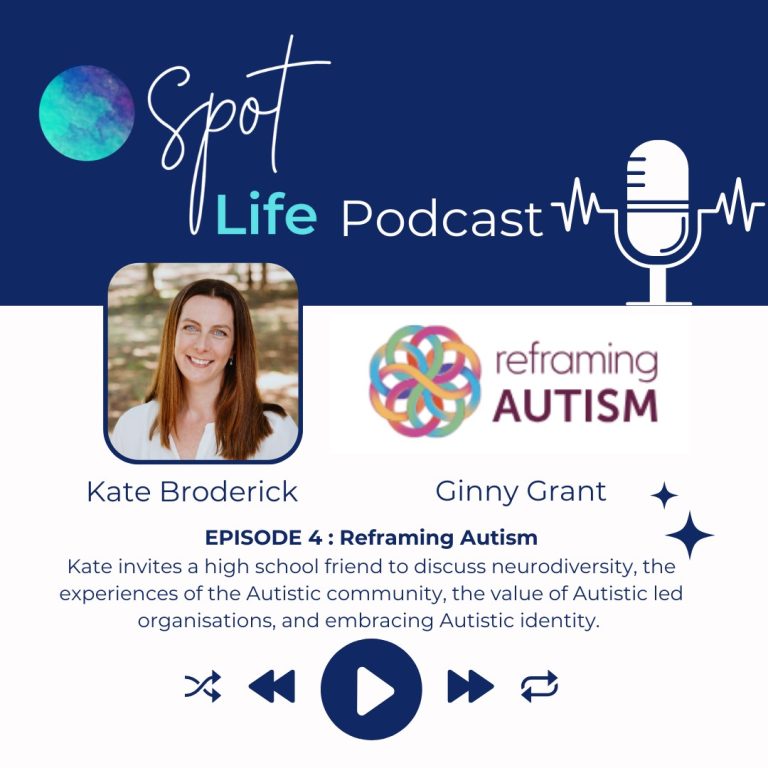
In this episode, Kate invites a high school friend to discuss neurodiversity, the experiences of the Autistic community, the value of Autistic led organisations, and embracing Autistic identify. Ginny shares her own story as an adult who found out she was on the Autism Spectrum. She also reflects on the way her own children's diagnoses caused her to develop a special interest in Autism. Ginny is the Communications Manager of Reframing Autism, which is a non for profit organisation run by and for Autistic people and their families and allies. They are dedicated to creating a world in which the Autistic community is supported to achieve acceptance, inclusion and active citizenship. Be sure to check out Reframing Autism on Instagram and Facebook.

Kate invites her high school friend, Ginny, to have a conversation about neurodiversity and the experiences of the Autistic community. Kate shares her insights as a mother of children with vulnerabilities not always well understood by the community. She is also an experienced therapist who has worked with many children over the years. These children have amazing talents and strengths but have also shared with Kate their stories of struggling with acceptance and understanding in the community.
Ginny is also a mother and strong advocate for neurodiversity. Ginny often shares personal insights and experiences with the online community. She is a part of a movement which encourages a culture of parents caring for one another, rather than judging each other. This community also raises awareness that the behaviour of children might not just be a result of bad parenting. Ginny is currently the Communications Manager of Reframing Autism.
Ginny was diagnosed with Autism last year at age 39. Her journey started in 2014 when she was part of a mothers Facebook group which discussed neurodiversity and the acceptance of Autism. Through these forums, Ginny became increasingly aware that both her children seemed to experience the world differently. Both her children were diagnosed with Autism in 2016. During this process, Ginny noted that her childhood experiences and the adult she had become, was extremely similar to her second child. This became the elephant in the room that Ginny and her husband did not discuss in detail.
Over the years, Ginny would use online diagnostic tools which always gave the result of “a strong likelihood of Autism”. Eventually, Ginny sent these reports to a close friend who was a paediatric Occupational Therapist. Her friend was hardly surprised and had in fact been contemplating for some time whether to tell Ginny that she suspected she was Autistic. This conversation gave Ginny the confidence to see her GP for a referral to a clinic that specialises in assessing adults for Autism.
Ginny was very concerned about being turned away from the clinic but at the same time she knew that she had strong signs of Autism and wanted to find out. During the waiting period for the assessment, Ginny found online communities with Autistic adults. She felt a strong sense of belonging and became friend with a few Autistic adults in real life. Ginny’s new friends were also very encouraging and validated her decision to go for an assessment.
Ginny found the assessment process very positive. The administrator explained that because Ginny’s Autism she had many specific strengths that were useful in society. Ginny reflects that it is a privilege to access an assessment as some people don’t have the opportunity. Also, a lot of people choose not to go down the path of getting an official diagnosis. For Ginny, this process was important for her to relate to her children’s experiences.
Ginny’s interest in Autism advocacy started to develop around 5 years ago when she was trying to understand what her children were experiencing. Ginny was deeply fascinated and found information on webinars, reading articles and watching videos. Autism became a special interest or intense passion. It is actually a common special interest amongst Autism adults. Ginny found that the aspects that she was most drawn to, were the people and advocates of Autism. She wanted to hear Autistic people’s experiences rather than reported data from studies. Ginny felt that she could naturally relate and connect to this community.
Ginny then became involved in the Yellow Ladybugs, a non-for-profit Australian and Autistic led organisation. This organisation advocates for Autistic girls, women and gender-diverse people. Ginny was responsible for organising events for young girls in NSW. Through this opportunity, Ginny become more involved in advocacy for acceptance and inclusion. Ginny also attended Reframing Autism workshops before becoming a founding board member when it became a charity. Ginny is now the Communications Manager of Reframing Autism.
Reframing Autism is a non-for-profit organisation run by and for Autistic people and their families and allies. It is dedicated to creating a world in which the Autistic community is supported to achieve acceptance, inclusion and active citizenship. Its main service is to provide education and advocacy for the Autistic community through a range of resources. An example is a retreat for families who recently received a diagnosis. During this trip, the families are educated about neurodiversity and what genuine acceptance is. Reframing Autism aims to reframe Autism, to change the lens of how Autism is viewed – to see the strength, value, joy and beauty instead of the traditional pathologized view where Autism is a deficit or disorder. Further information can be found on Reframing Autism’s Instagram and Facebook.
Health professionals are taught to say a person ‘with Autism’ or ‘is on the Autism spectrum’. While each Autistic individual has the right to be identified as they wish, it is widely known that the majority of the Autistic community prefers ‘identify first’ language. This is where we use ‘Autism’ first to acknowledge that Autism is fundamental to who an individual is. When the language is like ‘a person has Autism’, the word ‘Autism’ acts more like an accessory. By using identify first language, we highlight that Autism is how the individual experiences, senses, thinks, processes and moves in this world.
Ginny reflects that embracing an Autistic Identity is unique to each individual. For Ginny, she feels that an important aspect to is live authentically and being free to be our true selves. Many Autistic people will mask their Autistic traits in order to get by in social contexts. This might mean they mimic things they have seen or heard, or suppress stimming behaviours. Stimming or self-stimulating, repetitive behaviours have a very important purpose in helping Autistic people in self-regulate. All these masking behaviours can be extremely exhausting and detrimental. Suppressing one’s true identity is very taxing on emotional well-being and mental health.
Another aspect of embracing Autistic identity is to recognise the challenges. These challenges frequently stem from our society being set up for neurotypical people where expectations can be quite different. Equally important is to recognise individual strengths and passions. This includes allowing time and place to pursue these passions. Another means to embrace an Autistic identity is to be involved and interact with the Autistic community.
Neurodiversity is the concept that amongst humans there are different types of brains. This is a fact. There are neurotypical brains, which are the most common, and there are divergent brains. There are a range of divergent brains including ADHD brains, Autistic brains and many more. According to the neurodiversity movement, these divergent brains may be different to neurotypical brains but that is all. They are only different, not defective or disordered. They are also no less value for their difference. Acknowledging this simple idea of neurodiversity is a starting place for an acceptance approach. There is room for divergent brains in this world and each individual present with their own strengths and challenges. A world without neurodiversity would lack innovation, joy, novelty and inspiration.
A common concern in parenting and Autism communities is when parents want to consider having their child assessed but are worried about their child getting a “label”. This stems from the preconceived ideas of what Autism is and they are often entirely unfounded. A child who is denied an opportunity to see whether there is neurodiversity at play, often end up getting other labels. They go through the school system unsupported and sometimes can be bullied and ostracised. These children can get labelled as ‘weird’, ‘odd’ and ‘strange’. This happens because they are not supported effectively or surrounded by people who understand them. They miss the opportunity to thrive in the school system which carries onto adulthood. Many adults who are undiagnosed end up with even more labels including ‘lazy’ and ‘useless’. They are not supported by people who understand them and sometimes they might not understand themselves well. They are unable to experience acceptance and inclusion that can often come with others recognising that they are in fact Autistic.
Ginny shares her advice for families that are new to an Autism diagnosis. Her first piece of advice is to breathe and take a moment. She urges there is no urgency in the situation and the child is still the same child as before their diagnosis. The child is complete, whole and perfect as they are. The only difference is that the family now has some information that may help the family and others to better understand and support the child.
In Australia, there is a lot of information provided about NDIS funding and families are often overwhelmed by the logistics and paperwork. They feel pressured to book in appointments immediately but the most important consideration is to see the child’s development as an ongoing journey rather than an overnight change. Taking time to process the information and finding a therapist best suited to the child and family is vital. If a family or child doesn’t feel a connection to the therapist, it is likely they are not the best choice. It is also important to balance therapy with having a childhood. Therapy should focus on goals that will make the biggest difference for the child’s wellbeing and development.
Another suggestion is to start following Autistic voices. This includes Autistic led organisations such as Reframing Autism and Autistic self-advocates on social media (Facebook, Instagram, Twitter). Searching the hashtag #actuallyautistic will give insight into Autistic experiences that can really help families understand and ultimately embrace Autism.
This is another area frequently seen in parenting and Autism forums. Many parents feel that this is an extremely complex idea to tell a child. However, Ginny explains that only key points need to be addressed. Start with talking about differences of all kind. Normalise and celebrate differences. Also talk about strengths and acknowledge that everyone has strengths, challenges and areas that need support. Then, introduce Autism as a particular set of strengths, challenges and differences in a person.
Reframing Autism has a book called “Just Right for You” which is a warm and positive resource to approach a conversation about Autism. It talks about embracing differences. A resource good for older children is “The Awesome Autistic Go-To Guide: A Practical Handbook for Autistic Teens and Tweens” book by Tanya Masterman and Yenn Purkis. Finding resources that are produced by Autistic people highlights that a child is part of a community. This is better than resources with titles similar to “Johnny has Autism” which does not embrace the child as part of the Autism community. Acceptance and positive is a very important message for young people.
To find out more, contact us at SPOT Therapy Hub on spottherapyhub@gmail.com or 02 9389 3322. Also check out our podcasts and blogs on a variety of topics at www.spottherapyhub.com.au
Therapy Groups > Now Enrolling!
Help your child connect, communicate, and grow in a small, supportive group led by our experienced speech and occupational therapists.
Social connection & communication
Emotional regulation & play
Confidence in everyday communication
✨ Neurodiversity-affirming & trauma-informed care
✨ Individualised goals within a safe, inclusive environment
Spots are limited and fill quickly each term.